Metamodal Mastery
- Kelly L

- Jun 8, 2018
- 2 min read

"The ability to discover, create, produce, analyze, synthesize, integrate, and share data, content, artifacts, vocabularies, and epistemologies from a variety of fields in many collaborative modes and media, within and across metamodal platforms to enhance student learning"
Morbey and Steele (2013) suggest educators adopt a new concept: metamodal mastery. As an alternative approach to how literacy is traditionally viewed in the context of metamedia learning environments (227), it would shift boundaries between academic disciplines. They clarify the use of the term “mastery” as a means to favour the generation of new ideas, products, or perspectives (230). In order to achieve “metamodal mastery”, educators need to adopt an “epistemological hybrid” (231). Given the definition of this new concept as: “the ability to discover, create, produce, analyze, synthesize, integrate, and share data, content, artifacts, vocabularies, and epistemologies from a variety of fields in many collaborative modes and media, within and across metamodal platforms to enhance student learning” (231); I wonder what impact this “learning metaverse” may have for professional development of teachers? The opportunity for users of digital technology, according to John Seely Brown (2000), “to foster an entrepreneurial spirit toward creating new learning environments… that will use the unique capabilities of the Web to leverage the natural ways humans learn” (13) prompted a similar question: how do educators leverage mastery with the existence of unclear boundaries within Academia?
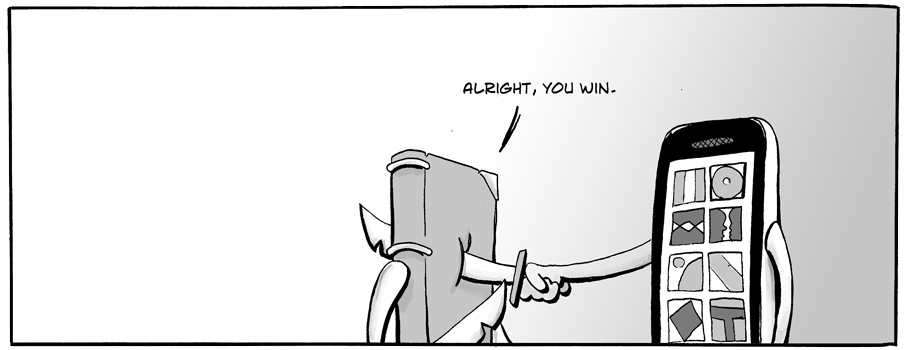
For me, Randy Glasbergen’s cartoon represents one of Morbey and Steele’s opening points about the divide that exists between student mastery in metamedia learning environments and university educators (226). The computer-savvy student is unfamiliar with the nuances of a book. This is representative of the divide that exists between the digital natives and existing structures within education that are out-dated. Additionally, this cartoons reminds me of Belshaw’s (2011) connection to Marshall McLuhan’s position: the context of a message needs to be explored in tandem with the medium within the culture to gain a full understanding of it or to be fully literate in the medium. Morbey and Steele suggest replacing literate with mastery as educators need to redefine their traditional notions of learning to include newer virtual mediums and the “remix” of content.
Reference:
Morbey, M. L., & Steele, C. (2013). Student mastery in metamodal learning environments: Moving beyond multimodal literacy (pp. 225-247). .


Comments